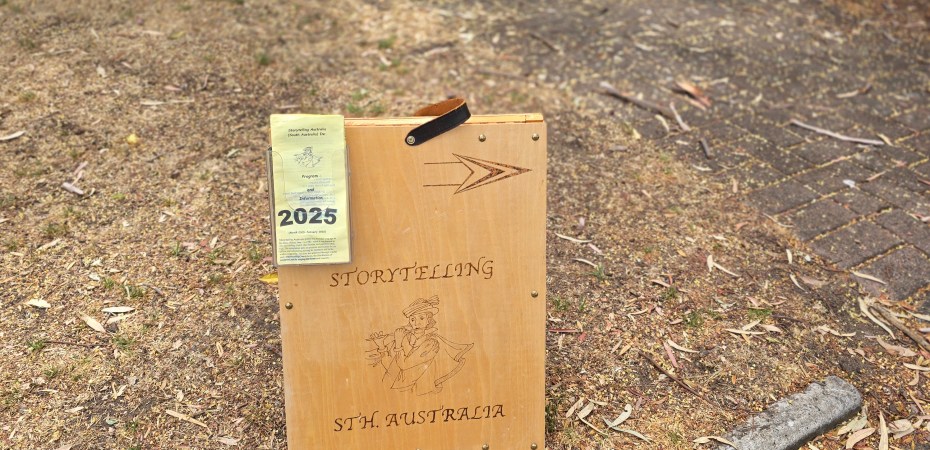
After the formalities of Storytellers South Australia, Adelaide Chapter’s AGM, Matthew Lykos talked to us about folklore music.
Why folk? Well, folklore (song) and storytelling share the same original platform ie the human voice. An oral tradition passed from mouth to ear, ear to memory, memory to community!!
Lykos spoke of singer circles and lilting refrains, of floating verses that shift and resettle depending on who is carrying them. It is the same mechanism storytellers can recognise instinctively: a narrative is never fixed as it breathes differently in each telling. In folklore, where structure was once porous, the original music was less rigid and more playable and verses floated. It was also different across the regions. For example, folklore in a Scottish village carried different tonal colours than one born from Mediterranean dance traditions or the nautical pulse of sea shanties.
The melody changed; the human need did not.
His reflection on Aboriginal song traditions was telling in its restraint. He acknowledged the limits of his ear, the difference in melodic language and the permissions required. In a time when cultural borrowing is easy and context is thin, that pause signals respect. Storytelling carries the same ethical dimension. Just because a story exists does not mean it is ours to tell.
And then there is the common Australian context. Bush poetry. Festival circuits. Songs once sung in kitchens now performed under marquees. Lykos noted that music increasingly lives in festivals rather than homes. The same could actually be said of storytelling. His comments hit home about our ‘performance society’. We curate it. Ticket it. Program it.
Perhaps the most striking parallel lies in audience participation. Lykos tries to dissolve the stage, look people in the eye, and make the room feel like an RSL on a Friday night where everyone has a turn.
One to ponder.
Both folk song and storytelling:
- emerge from oral tradition
- adapt to place
- rely on repetition and variation
- invite participation
- demand ethical awareness of ownership
- survive through community, not hierarchy.
Lykos, trained in opera but with resistance to its feudal hierarchy, chose the pub over the pedestal. In doing so, he articulated a broader question for storytellers: are we building stages, or circles?
If folklore teaches us anything, the future lies in the smaller, braver rooms where the line between teller and listener dissolves.
- NEWSLETTER ONE | Dear Greys… we count the days
- The Quiet Deficit in Our Diet
- Curious. What do you read?
- Diary of a downsizer. Chapter 2: Decluttering, Decommissioning and Destroying
- Fashion sanity in a wardrobe capsule
Discover more from GreyMatter.StudioLife
Subscribe to get the latest posts sent to your email.
